
Running a Sex Offender Check in Amador County
The California Megan's Law Website is the official public search for Amador County. It displays information from the California Sex and Arson Registry, or CSAR, when state law permits public disclosure. Local police and sheriff agencies collect registration updates and send them to the California Department of Justice. DOJ then updates the website each day from those reports. No separate official Amador County offender map was documented in the research.
A name or location result is a safety aid, not a full background file. Some people who must register are excluded from public display. Others appear with a home address or only a ZIP Code, city, and county. DOJ also warns that details change fast and can contain gaps. Match more than a name, read the posting category, and contact law enforcement when a material fact looks wrong.
The California DOJ registry overview identifies the state systems and the role of local registration agencies. The official overview is captured below.
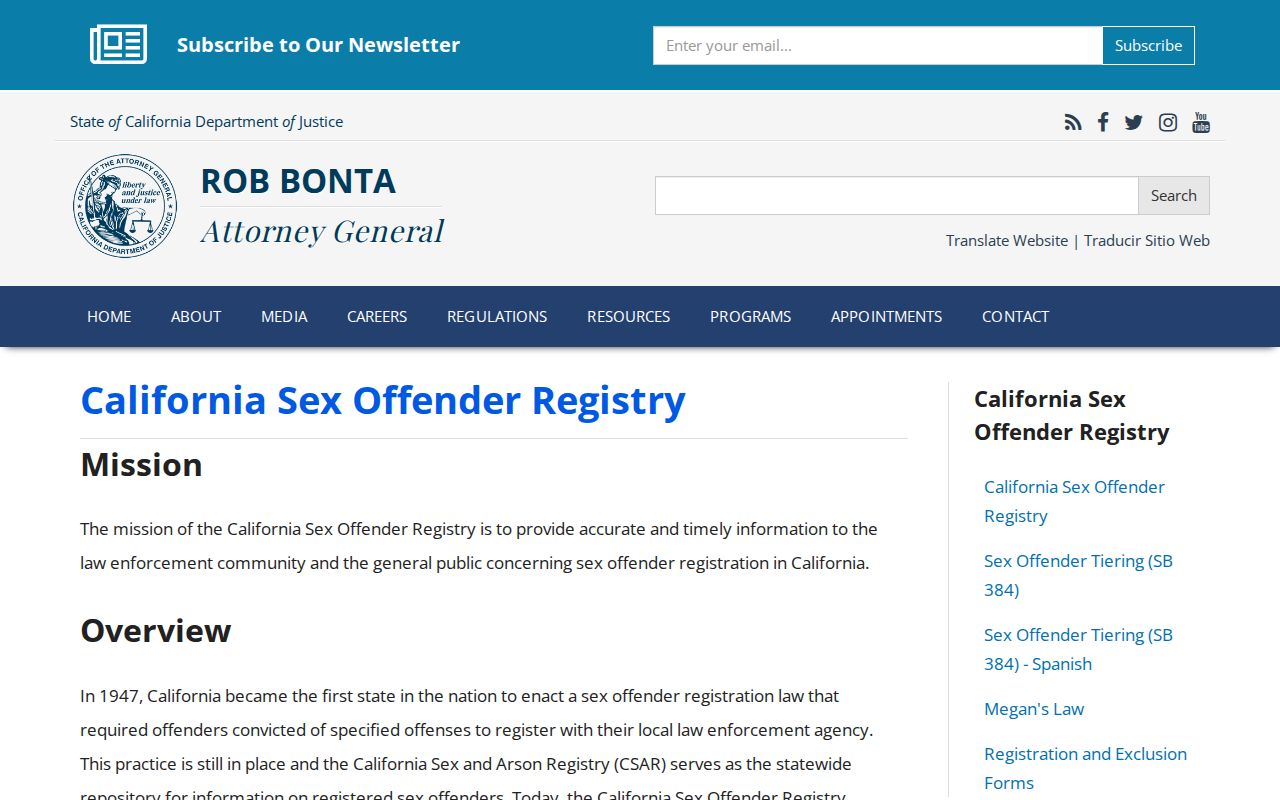
That source is the best place to confirm current state guidance before interpreting an Amador County registry result.
How Amador County Registry Data Moves
California began sex offender registration in 1947. Today, local agencies register people within their jurisdiction and forward the data to DOJ's CSAR repository. The Megan's Law website publishes the part that Penal Code section 290.46 makes public. This flow explains why a local correction may take time to reach the public site, even though DOJ says it updates the site daily.
Registry flow: Local Registration › CSAR Submission › DOJ Processing › Megan's Law Public Display
The official Megan's Law summary explains how the public website draws from CSAR. Its summary page is shown here without exposing any individual registrant.
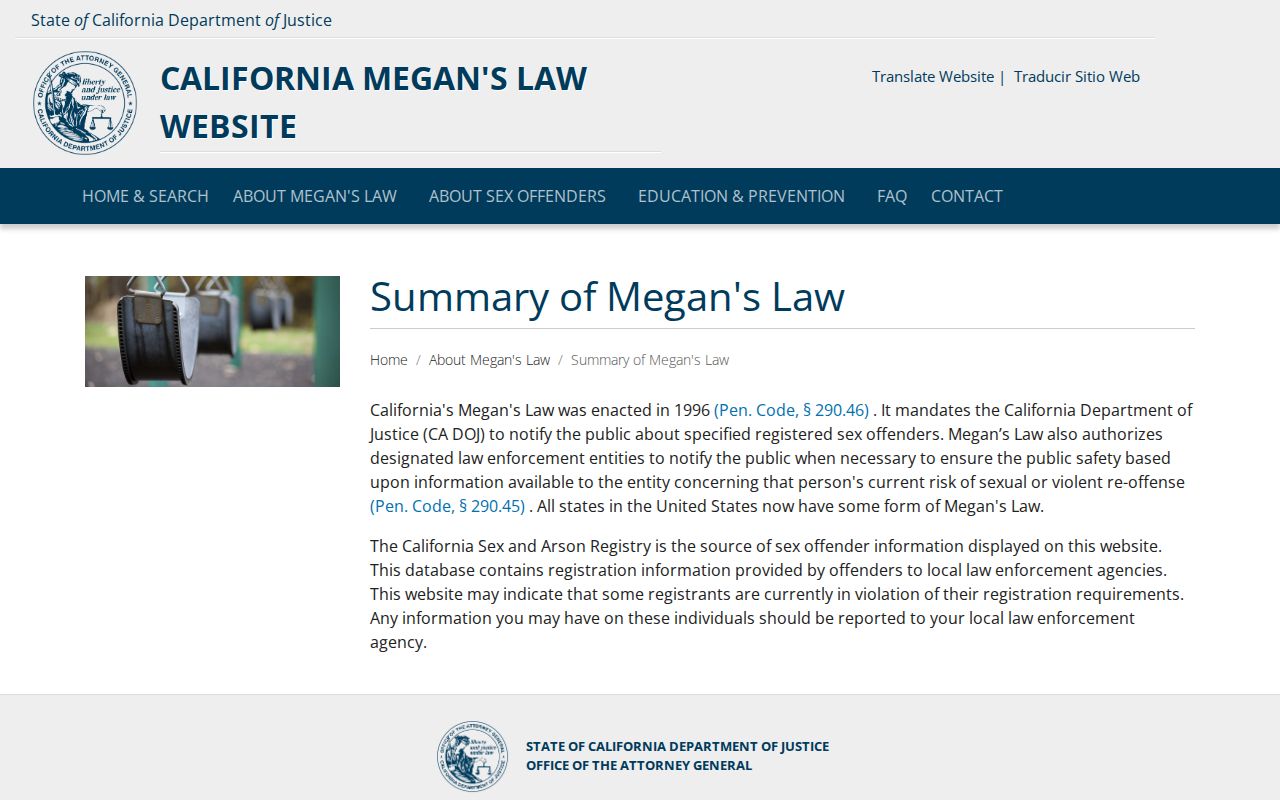
A public profile is therefore only the authorized display layer, not every record held by CSAR or an Amador County registration agency.
Searching the California Megan's Law Website
The search begins with a disclaimer. A user must read and acknowledge it before continuing. After entry, the official interface supports name and place-based searching, including address, city, ZIP Code, or county. The exact radius labels and map options were not captured in the official text, so they should be read on the live form rather than assumed. Start with the least broad location that fits the safety question.
- Open California Megan's Law and read the conditions, limits, and lawful-use notice.
- Acknowledge the disclaimer and continue to the public search interface.
- Search by name or use the available address, city, ZIP Code, or county controls for Amador County.
- Compare identifying details and open the profile only after checking that the result is the intended person or place.
| Field or Control | Type | Required | Notes |
|---|---|---|---|
| Disclaimer acknowledgement | Acknowledgement | Yes | Must be accepted before the search opens. |
| Continue | Button | Yes | Moves from the warning to search. |
| Name search | Text | No | Visible after entry; verify all live labels. |
| Address, city, ZIP, or county | Text or selection | No | Supports a place-based Amador County check. |
| Map or list view | Interface | Unconfirmed | Use the live site's current controls and options. |
Because the research did not confirm each live label, rely on the current state interface and do not assume an unlisted radius or alert feature.
Amador County Posting Categories
California's public display categories affect what an Amador County search can show. A home-address category publishes the home address. A ZIP Code category publishes the ZIP Code, city, and county instead. A conditional category may move a person from ZIP-only display to home-address display after another registrable conviction. The non-public category covers some people who must still register but cannot be shown under current law.
Narrow exclusions may also be granted under Penal Code section 290.46(d) for specified offense, family-victim, and probation criteria. DOJ materials say processing may take 30 to 90 days or longer. Thus, an empty map point or missing name cannot establish that no registration duty exists. It may reflect a search mismatch, a posting category, a lawful exclusion, or delayed local data.
Note: California Megan's Law is a public-disclosure system, not a complete list of every person subject to registration.
What a Registry Profile Shows
DOJ's official description supports a limited field inventory. A public profile can show a registrant's name and identifying information, the applicable address category, the offenses that require registration, and a violation status when update rules have not been met. State law does not allow the site to disclose unrelated offenses. DOJ also has risk-assessment information, but its disclaimer says the agency has not assessed the displayed person's specific future risk.
| Name and Identity | Registrant name and public identifying information supplied by the official system. |
|---|---|
| Address Category | Home address or ZIP Code, city, and county, depending on the legal posting category. |
| Registration Offense | Only offenses that require registration and may lawfully be disclosed. |
| Violation Status | May flag failure to meet registration update duties. |
| Display Limits | Some registrants and some data remain non-public by law. |
| Risk Context | DOJ states that it has not assessed a displayed person's specific future risk. |
A reader should not infer extra profile fields that the research did not confirm. No sample Amador County individual profile was collected, and private identifying details should not be republished.
Amador County and NSOPW
The National Sex Offender Public Website, or NSOPW, adds a cross-state layer. It can help when an address near Amador County involves travel, a past residence, or another state. The California Megan's Law Website remains the primary source for California posting rules and profile context. Results may differ because each jurisdiction controls which records are public and how its data reaches the national search.
The official NSOPW interface is captured below. It offers a broad search route without replacing California's source page.
When the national result and the state page seem to conflict, verify the current Amador County entry with California DOJ or the local law-enforcement agency.
Registration Requirements and Levels in California
California's official summary sets update duties by circumstance rather than by a simple public risk level. A person must register with the law-enforcement agency that has jurisdiction over the residence within five working days after release into the community. Address changes and a change to transient status also must be reported within five working days. Most registrants update each year near their birthday. Transients and sexually violent predators report more often.
| Registration Group | Public Duration | Update Frequency |
|---|---|---|
| Resident registrant | Not stated in the harvested source | Annual update within five working days before or after birthday |
| Transient registrant | Not stated in the harvested source | Every 30 days |
| Sexually violent predator | Not stated in the harvested source | Every 90 days |
| Address or status change | Not applicable | Within five working days |
The California registration-law summary is the source for these time rules. The page shown below should be checked for later amendments.
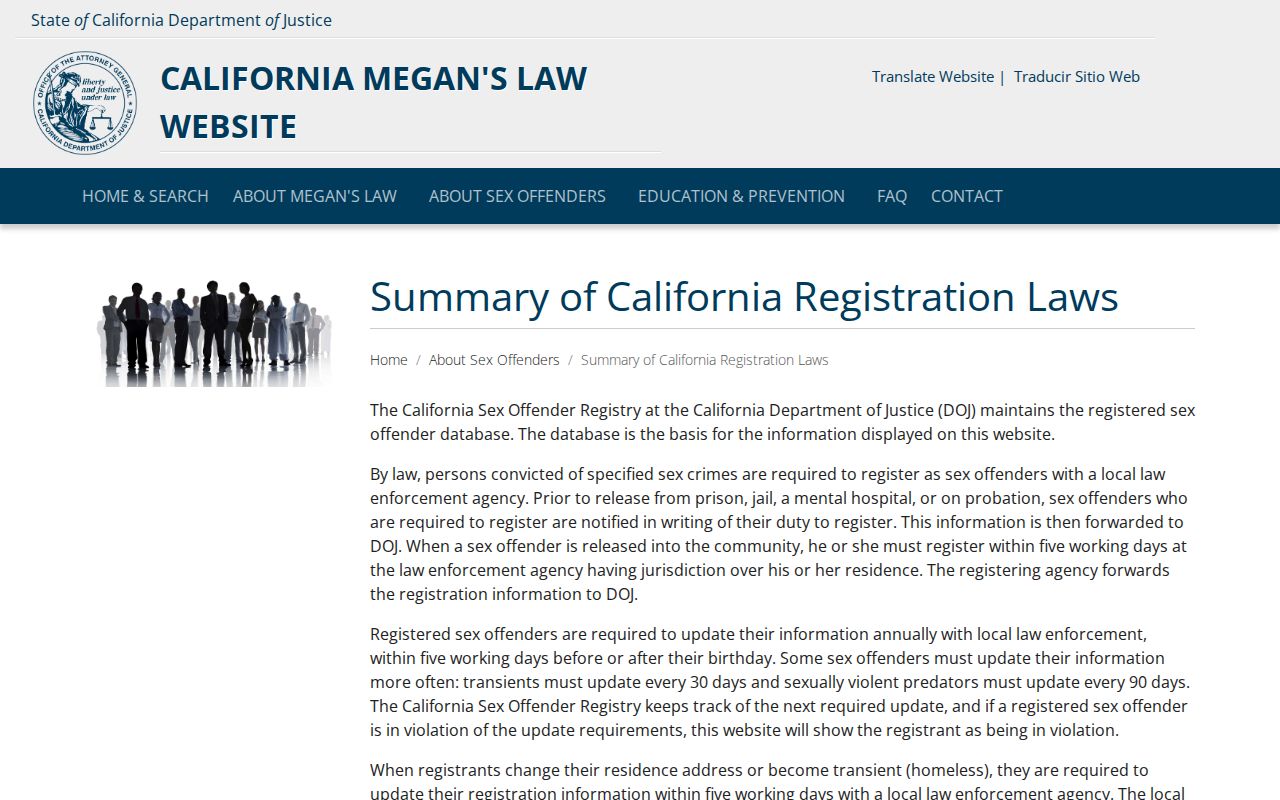
These update schedules concern the duty to report. They do not guarantee that every change appears on the public website at once.
Amador County Registration Office
The Amador County Sheriff's Office public-information menu includes offender registration. Its main office is at 700 Court Street, Jackson, CA 95642, and the main number is (209) 223-6500. The harvested official text did not confirm a separate unit name, set hours, appointments, or fees for sex offender registration. A registrant should call the office for current instructions instead of relying on an assumed schedule.
Amador County Sheriff's Office
Offender registration
700 Court Street
Jackson, CA 95642
(209) 223-6500
Members of the public should use the Megan's Law search for public information. Registration counter records and the website are different channels, and not every fact held by law enforcement can be disclosed.
Correct an Amador County Registry Error
DOJ warns that registry information can change quickly and may contain gaps because it comes from law-enforcement reports and information supplied by registrants. A mistaken identification is also possible when someone relies only on name, age, and address. Compare the whole public profile. If the concern remains, report a possible correction to the police or sheriff's department or email DOJ at MegansLaw@doj.ca.gov.
For suspected failure to update, give law enforcement the public profile and the specific fact that appears stale. Do not confront the person or publish an accusation. A violation status may appear, but an online omission is not proof of a new crime. The agency can compare public information with records that cannot be released to the caller.
Lawful Use and Community Notification
Registry information may be used to protect a person at risk and to make sound family or community safety plans. It should be read with the official disclaimer. DOJ says it has not judged a displayed person's specific future risk, some registrants are not shown, and public facts may be incomplete or no longer current. Harassment, threats, vigilantism, and the use of registry data to commit another crime violate the purpose and may violate California law.
The official misuse-penalties page details the consequences under Penal Code section 290.46. Its warning page is shown below to keep the legal limit next to the Amador County search process.
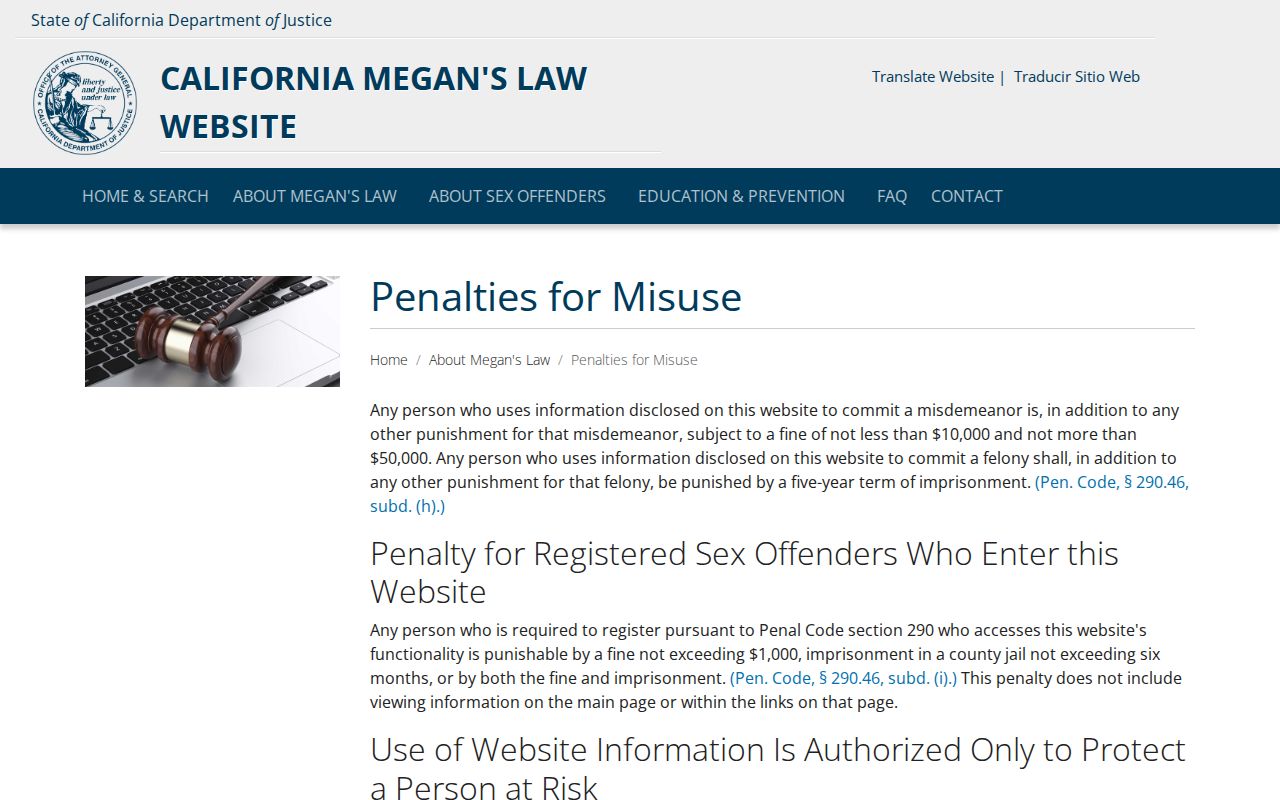
Those penalties can apply in addition to liability for the underlying act, so public access must remain tied to lawful safety use.
Misuse is a crime: Penal Code section 290.46(h) can add a $10,000 to $50,000 fine for misdemeanor misuse and five years for felony misuse; subsection (j) also permits civil damages and penalties.